BI Blog
What Is White Label Market Research? How It Works for Agencies and Consulting Firms
White label market research is custom research that an outside research firm designs and carries out, and that a marketing agency or consulting firm then delivers to its own client under its own brand. The client sees the agency’s name on the findings. The research partner stays in the background, bound by an NDA.
It is a common way to add capacity. In the AgencyAnalytics 2023 benchmarks survey of 121 agencies, 81% outsourced at least some of their work, and the report names white label service partners as one of the ways agencies bring in skills they do not keep in-house. Yet search for the term today and most results describe white label software, dashboards or reporting tools, not research. This guide explains what the research version actually is, how it works, what it costs, and what to check before you use it.
What is white label market research?
White label market research is original research, such as a market brief, a competitor audit, a market size or a set of customer interviews, produced by a specialist firm and presented by another firm as its own work. It answers your client’s specific question. It is not a subscription report or a data feed with a new logo.
Four traits define it:
- Custom scope. The research is built around one client question, not resold from an existing library.
- Your brand, not the partner’s. The deliverable is unbranded or co-branded, in your template.
- Confidentiality. An NDA is signed before work starts, and the end client’s name can stay out of the brief.
- Analyst work. People design the method, gather the evidence and check every source before it reaches you.
How is white label research different from white label software or reports?
The phrase “white label” covers very different products. Most agency tools sold as white label are software: you rebrand a dashboard or an automated report and pass it to clients. White label research is a service: analysts produce new evidence for one decision.
| White label software or reporting | White label market research | |
|---|---|---|
| What you get | A rebranded tool or recurring report on existing metrics | New research that answers your client’s question |
| Who does the work | Software on a data feed | Analysts running desk and primary research |
| Pricing | Monthly subscription per seat or client | Per project, scoped to the question |
| What your client sees | A dashboard with your logo | A report or deck under your name, with sources |
How does white label market research work?
A typical engagement runs in four steps, from a short brief to a finished deliverable your team presents.
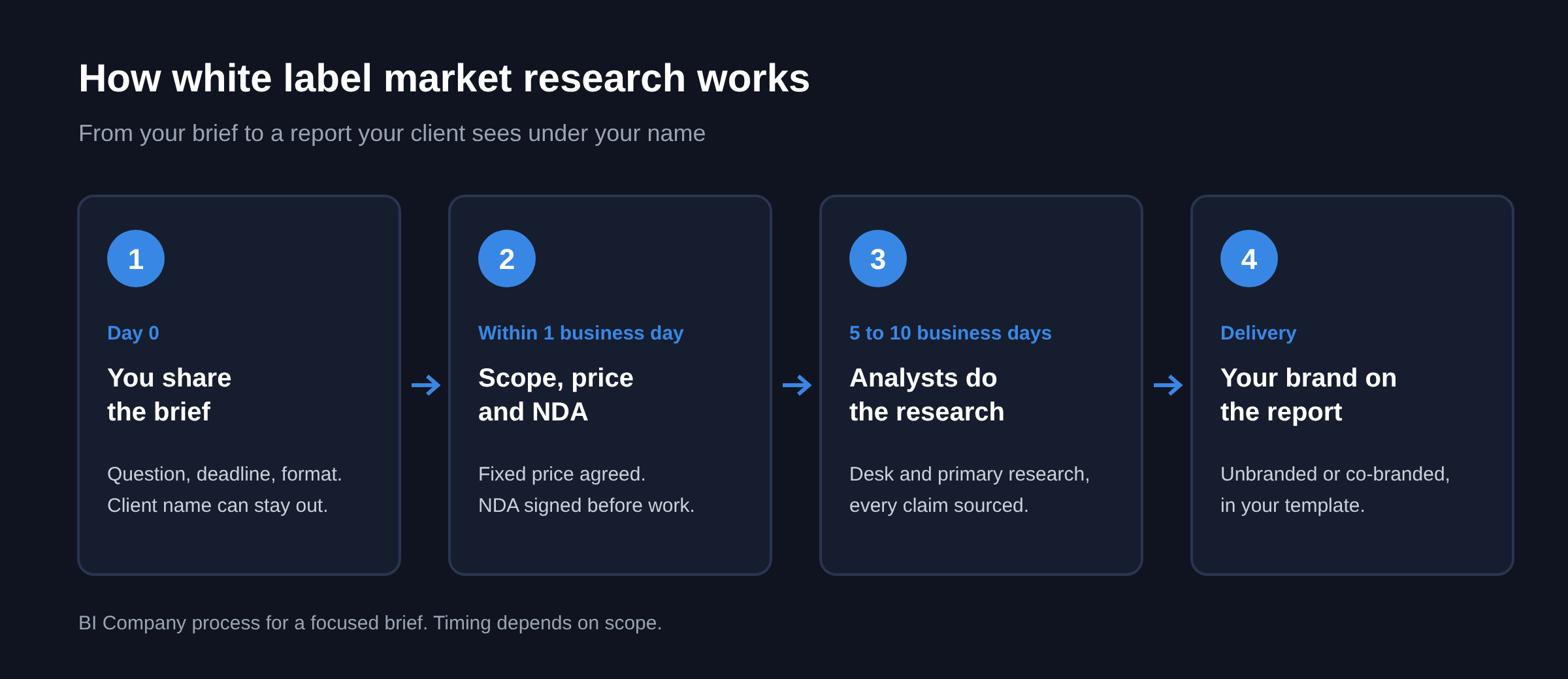
- You share the brief. The question, the deadline and the format you need. You can leave out your client’s name.
- Scope, price and NDA. The partner comes back with a fixed price and a plan. The NDA is signed before any work starts.
- Analysts do the research. Desk research, and primary research such as interviews or surveys when the question needs it. Every claim carries a source.
- You deliver it under your brand. The findings arrive in your template, unbranded or co-branded, ready for your strategy deck or client meeting.
At BI Company, scoping takes up to one business day and a focused brief typically takes 5 to 10 business days. Larger projects with fieldwork take longer, and the timeline is agreed before work begins.
What can agencies and consulting firms outsource this way?
Most research a client asks for can be produced on a white label basis. The most common requests are:
- Market and industry briefs: trends, drivers and key players in a client’s category before a pitch or a strategy refresh.
- Competitor audits and competitive intelligence: positioning, pricing signals and gaps across rivals. See our competitive intelligence services.
- Market sizing: a TAM, SAM and SOM with the method shown, for an RFP or a business case.
- Primary research: B2B interviews, surveys and focus groups, including recruitment of specialist B2B audiences.
- Secondary research: published sources found, checked and cited, so the numbers in your deck hold up.
Why do agencies and consulting firms use white label research?
The main reason is capacity. Many clients now expect strategy backed by evidence, but most small agencies and boutique consultancies cannot keep a full research team busy all year. Outsourcing the research while keeping the client relationship lets them say yes to research work without adding fixed headcount.
Demand for that evidence keeps growing. The Insights Association’s 2026 State of U.S. Insights and Analytics Report found that the U.S. insights and analytics industry grew 7.8% in 2025 to $89.3 billion.
That U.S. figure covers a broad industry, including data analytics and research technology. ESOMAR’s Global Market Research 2025 sizes the narrower market research sector worldwide at about $56 billion in 2024, so the two numbers measure different things.
For consulting firms the logic is similar: partners bring judgment and client trust, while an outside research team handles sourcing, desk research and fieldwork, as in our white label market research for consulting firms. We cover the model in detail in an outsourced research team for consultants: when it beats hiring.
What should you check before choosing a white label research partner?
Your name goes on the work, so the partner’s standards become yours. Before you sign, check that the partner:
- signs an NDA before you share any brief details;
- cites a source for every number and can show its method;
- has analysts verify the research, rather than delivering unchecked AI output;
- can run primary research, not only desk research, when the question needs it;
- delivers in your template, unbranded or co-branded, with no partner logos left in files;
- gives a fixed price and timeline before work starts;
- does not need your end client’s name to do the work.
Our market research best practices checklist covers how to judge whether the data itself can be trusted.
How much does white label market research cost?
Price depends on the scope: the number of questions, markets and competitors, and whether primary research is needed. At BI Company, white label projects start from $1,500, with a fixed quote agreed before work begins. Projects with interviews, surveys or several markets cost more, and the quote shows exactly what is included.
Frequently asked questions
Does the end client know a research partner was involved?
That is your decision and depends on your agreement with your client. Some agencies deliver the research fully unbranded, others prefer a co-branded report. The research partner follows your choice and works through you.
Who owns the research after delivery?
Ownership terms are set in the contract. In a typical white label engagement the deliverable is handed over for you to use with your client, and the partner keeps it confidential.
Can white label research include interviews and surveys?
Yes. White label research is not limited to desk research. A partner can recruit B2B respondents, run interviews, surveys or focus groups, and deliver the findings under your brand.
How long does white label market research take?
A focused brief typically takes 5 to 10 business days at BI Company. Projects with fieldwork or several markets take longer, and the timeline is agreed during scoping.
Is white label research the same as hiring a freelancer?
Not quite. A freelancer usually adds one person’s time. A white label research partner provides a team with a set method, source checking, primary research capability and an NDA, and takes responsibility for the whole deliverable.
Ready to add research capacity under your brand?
Send a short brief and get a fixed scope and price within one business day. Learn more about white label market research for agencies.
Sources: AgencyAnalytics, “Marketing Agency Management Insights: 2023 Benchmarks Report,” August 3, 2023 (survey of 121 agencies). Insights Association, “U.S. Insights and Analytics Industry Reaches $89.3 Billion as AI and Technology Reshape the Market,” 2026 State of U.S. Insights and Analytics Report, August 2026. Lilas Ajaluni, “Inside the $153bn Insights Industry,” Research World (ESOMAR), November 4, 2025, excerpt from ESOMAR Global Market Research 2025.