BI Blog
Competitive Intelligence Services for B2B and SaaS Companies
Fifty-two percent of competitive intelligence programs do not have a sales executive sponsor, and 85 percent of those same programs say acting on the intelligence is sales enablement’s job, according to Crayon’s 2025 State of Competitive Intelligence report, based on data from hundreds of product marketers, CI professionals, and sales enablement leaders. Sellers run into a named competitor in 68 percent of deals the same report tracked, and the average team rates its own competitive selling at 3.8 out of 10.
The pattern is familiar if you have sat through a competitor review before. A deck full of screenshots, pricing pages, and feature comparisons, with no clear answer to the question that actually matters: what should we do differently starting Monday?
If your team already collects competitor data and still struggles to act on it, the problem usually is not more monitoring. It is that nobody turned the signals into a specific, defensible recommendation. That is the gap BI Company’s competitive intelligence engagements are built to close.
Why competitor tracking is not the same as competitive intelligence
Tools like Klue, Crayon, and AlphaSense are built to monitor public signals: pricing page changes, new job postings, review mentions, release notes. They are useful, and 44 percent of companies in the same 2025 Crayon survey still lack basic competitor visibility inside their own CRM, so most teams have room to improve even at that first layer.
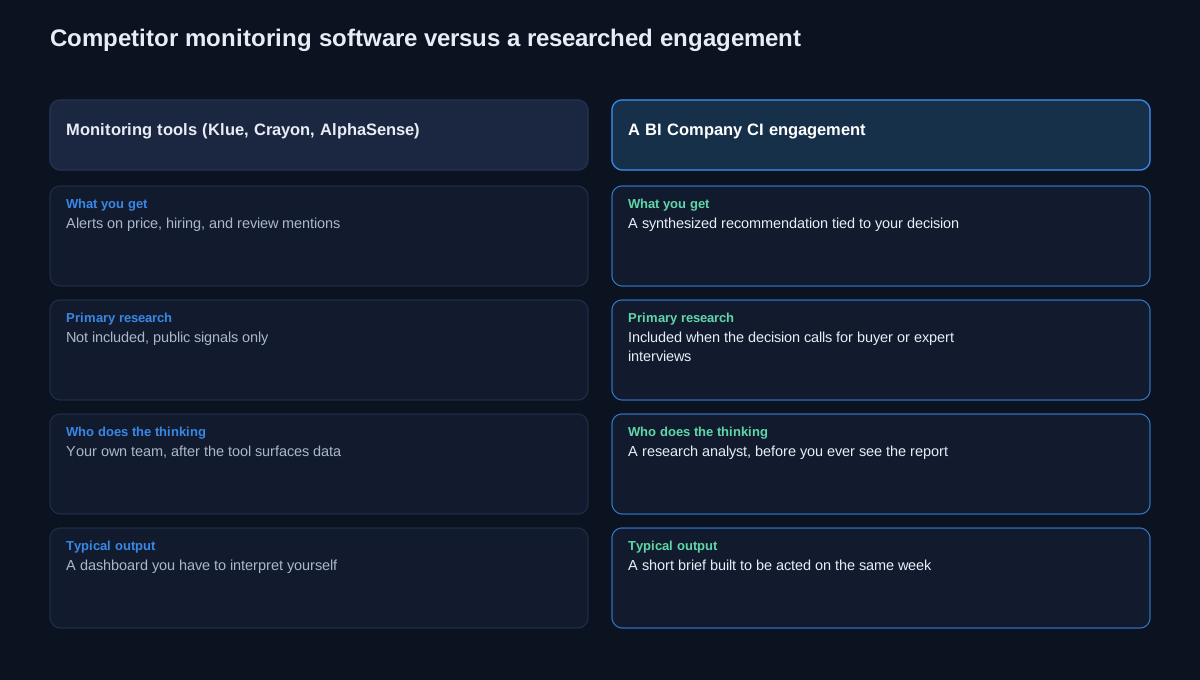
But a monitoring tool stops at the alert. It tells you a competitor changed something. It does not tell you whether that change matters to your roadmap, your pricing, or the deal you are trying to close this quarter, and it does not draft the response. That synthesis step, deciding what a signal means and what to do about it, is the part most internal teams do not have the bandwidth to do consistently. It is the part a researched engagement is built to deliver.
BI Company is a research and intelligence consultancy, not a monitoring platform. We do not sell a dashboard. We deliver a researched answer, with a human analyst behind every recommendation.
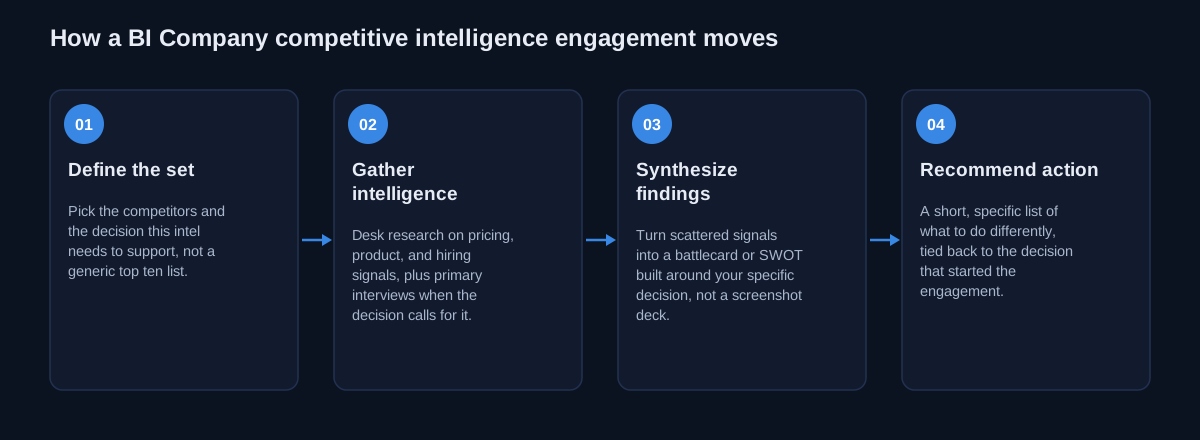
What a competitive intelligence engagement includes
- A competitive set scoped to your actual decision, a pricing move, a new feature, a market entry, or a specific deal, not a generic top ten list
- Desk research across pricing, product changes, hiring signals, and public positioning for every competitor in scope
- Primary research when the decision calls for it: practitioner interviews, win and loss conversations, or a structured mystery shopping evaluation of a competitor’s own buying experience
- A synthesized battlecard, SWOT, or positioning brief built around your decision, not a folder of screenshots
- A short list of specific recommended actions, the part most internal reviews stop short of
Monitoring software and a researched engagement solve different problems
Most of the companies we work with already have a monitoring tool in place, or at minimum a shared document someone updates when they notice something. What they are missing is the second half of the job: synthesis and a decision. That is where this engagement starts, not where it stops.
Who asks us for this
- B2B and SaaS companies that need an answer to a specific competitor move, a pricing cut, a new feature, or a new entrant, before the next planning cycle
- Consulting and advisory firms that need competitive intelligence as outsourced capacity for a client deliverable. If this is a recurring need rather than a one-off, our outsourced research model for consulting firms covers the ongoing capacity option
- Marketing and advertising agencies delivering competitive intelligence to their own clients without hiring an in-house analyst, the same way they already lean on us for white label market research
- Investors and corporate strategy teams validating a target company’s competitive position before a decision, often alongside a market sizing check
What it costs
Engagements start from $1,500 and scale with scope. A single competitor battlecard costs less than a full competitive landscape covering primary interviews across several competitors. You get a fixed price agreed before work starts, not a time and materials estimate.
A quick check: does this fit what you need
- You already collect competitor data, alerts, a shared document, or a monitoring tool, but nobody turns it into a decision
- A competitor just made a move, a price change, a new feature, a funding round, and you need an answer before your next planning cycle, not a slide deck of what happened
- You are evaluating a target company’s competitive position before an investment or acquisition decision
- Your last internal competitor review produced a lot of screenshots and no actual recommendation
If two or more of these are true, a researched competitive intelligence engagement is worth scoping before the next competitor review repeats the same pattern.
FAQ
How is this different from competitive intelligence software like Klue or Crayon?
Software monitors public signals and sends alerts. We start where the alert leaves off: deciding what a signal means for your specific decision and delivering a recommendation, not a dashboard you still have to interpret.
Do you only do desk research, or primary research too?
Both. Desk research covers pricing, product, hiring, and public positioning. Primary research, structured interviews or a mystery shopping style evaluation, is added when the decision needs more than public signals can show.
How fast can this be turned around?
Most single-competitor or single-decision engagements deliver in 5 to 10 business days from scope confirmation, matching the timeline on our other research engagements. Tighter deadlines can sometimes be accommodated. Ask about this when you send the brief.
Do you sign NDAs and can this stay confidential?
Yes. Engagements are confidential by default, and the output is formatted to go straight into your own strategy deck or board materials.