BI Blog
An Outsourced Research Team for Consultants: When It Beats Hiring
An Outsourced Research Team for Consultants: When It Beats Hiring
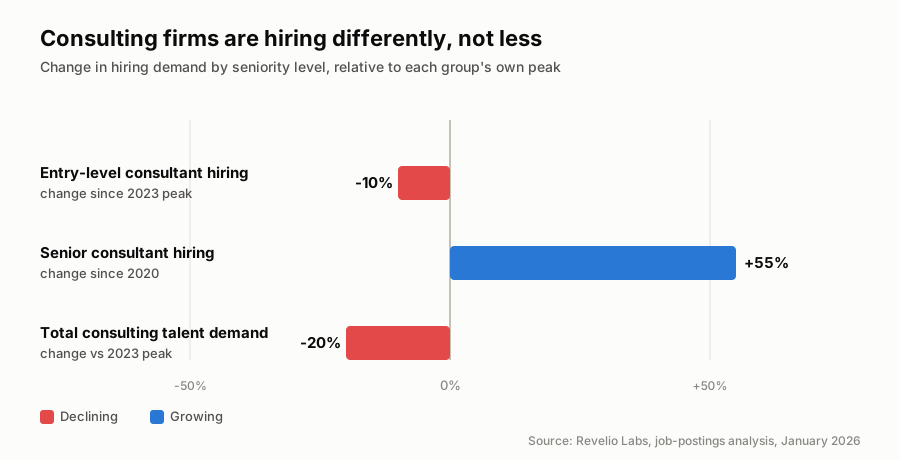
In December 2025, McKinsey told staff it would cut up to 10 percent of roles in divisions that do not face clients, after its headcount had already slid from a 2022 peak above 45,000 to roughly 40,000. Bloomberg reported in April 2026 that further cuts were still coming over the following year and a half. The pattern is not limited to one firm. Revelio Labs’ analysis of consulting sector job postings, published in January 2026, found total hiring demand across the industry running about 20 percent below its 2023 peak. Within that pool, the same analysis found consultant role demand down close to 40 percent since 2023, senior consultant hiring up 55 percent since 2020, and entry level consultant hiring, the layer that used to staff market sizing decks and competitor teardowns, down 10 percent from its own 2023 peak. The same report found that AI roles inside these firms now outnumber entry level consultant roles for the first time, reversing a ratio that ran roughly four junior consultants for every AI role as recently as 2015.
If you run research, knowledge management, or practice operations at a consulting firm, none of this is news to you. The junior bench that used to absorb a same week market sizing request or a competitor teardown before a pitch has gotten thinner, while the client work asking for that evidence has not slowed down. The real question in front of you is not whether that capacity gets rebuilt. It is whether it gets rebuilt as a headcount line, or as an outsourced research team you can call on only when a brief actually needs it.
Why this is a capacity problem, not a motivation problem
This is not a story about firms losing interest in evidence based work. Partners still need a defensible market size before a pitch, a competitor teardown before a renewal conversation, and customer evidence before a strategy recommendation goes to a client’s board. What has changed is who is available to produce it. The Big Four cut more than 9,000 jobs in 2023 alone, after overhiring through the 2021 and 2022 recovery, and headcount at that layer has not been rebuilt since. Layered on top of that is a second shift: firms are redirecting the budget that used to fund junior research hires toward AI tooling and senior, client facing talent instead. The result is a research and analysis workload that has not shrunk, landing on fewer people who already have a full client case load.
What actually changes when you hire for this instead of outsourcing it
The honest comparison is not which option is cheaper in the abstract. It is what changes operationally once the decision is made.
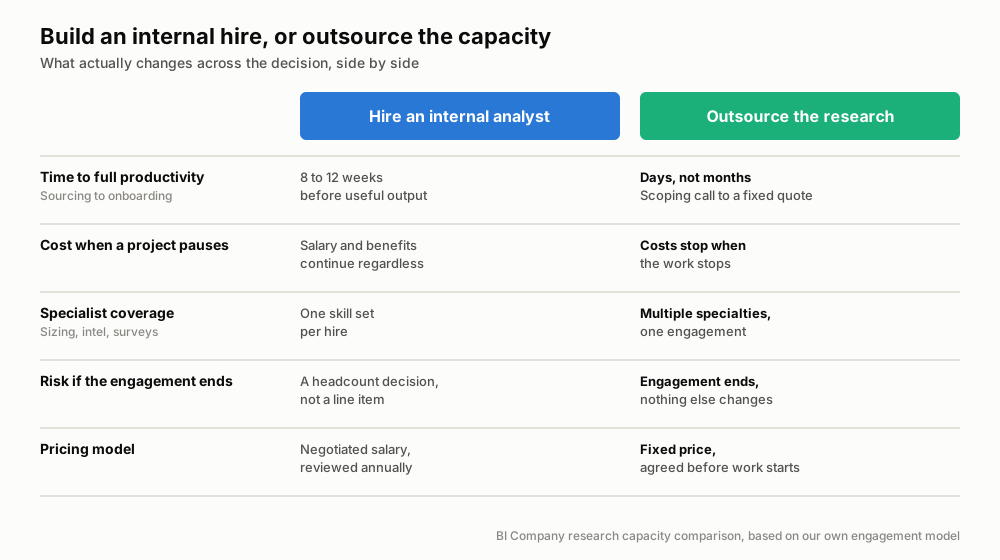
The starkest difference is the cost structure, not the sticker price. A salaried research hire is a standing cost whether or not there is a brief to staff this month. A fixed price outsourced engagement only costs money while there is active work on it, and the cost stops cleanly when the engagement ends. For a firm whose research demand spikes around specific pitches and renewal cycles rather than running at a steady weekly volume, that difference in utilization is usually where the real money is, not in comparing one person’s time against another’s.
Where outsourcing actually fits a consulting firm’s workflow
Outsourcing tends to earn its place in three specific situations, based on the engagements that come through our own pipeline:
- A pitch or renewal on a short clock. A market sizing model or a competitor teardown is needed in days, not after a hiring and onboarding cycle, and there is no spare capacity on staff to pull from client work.
- A specialist skill the firm does not keep in house. Primary survey fieldwork, international desk research, ongoing market intelligence tracking, or a methodology the firm uses rarely enough that hiring a permanent specialist for it would sit idle most of the year.
- Smoothing demand so billable staff are not pulled off client work. Internal research requests compete with client deliverables for the same people’s time. Routing that internal demand outside the firm protects the hours that actually bill.
This is the model we built our own outsourced research service for consulting firms around: a scoping call, a fixed quote starting from $1,500 that scales with what the brief actually needs, no retainer, and deliverables that can carry the firm’s own name rather than ours.
Where hiring is still the right call
Outsourcing is not the answer in every case, and a firm that treats it as one will end up disappointed. If research is a genuine, sustained, full time need, if it needs to be embedded in a specific client relationship over months, or if the methodology itself is part of what makes the firm’s advice distinctive, a permanent hire who builds institutional knowledge over time is still the stronger choice. Outsourcing suits variable, episodic, or spike demand. It is a poor substitute for a role the firm needs filled at full utilization, every week, indefinitely.
A short decision check
Before deciding either way, it is worth answering these honestly:
- Does the need recur every week at a steady volume, or does it spike around specific pitches and deadlines?
- Does the work call for a skill the firm does not already have on staff, such as fieldwork, TAM modeling, or international desk research?
- Would a new hire stay fully utilized for the next twelve months, or would utilization dip noticeably between engagements?
- Does the deliverable need to be built and owned internally, or is it acceptable for it to be produced externally and carry the firm’s own name?
A firm answering “spikes,” “a skill we lack,” “it would dip,” and “white label is fine” is usually better served by outsourced capacity than by a new line on the org chart.
Who this works for
This fits boutique consulting firms running lean without a dedicated research function, management consulting practices riding out a hiring freeze while client demand for evidence has not eased, and independent partners pitching new work without a staffed research bench behind them. It is less suited to a practice that has already built a large internal research team and is optimizing that team’s output, rather than deciding whether to build one at all.
If the data at the top of this article sounds like what you are navigating right now, it is worth a conversation before the next pitch deadline forces the decision for you.
Talk through your research capacity options
Frequently asked questions
Is outsourcing research cheaper than hiring an analyst?
It depends on utilization more than on any day rate comparison. A fixed price engagement only costs money while there is active work on it. A salaried hire is a standing cost whether a brief is in progress or not. For firms whose research demand is uneven across the year, that utilization gap is usually the bigger factor, not which option looks cheaper on paper for a single project.
How fast can an outsourced research team actually start on a brief?
With our own model, it is a scoping call followed by a fixed quote, then research and analysis begin once the quote is accepted. That is a matter of days, not the weeks or months a hiring and onboarding cycle takes before a new analyst produces anything useful.
Can outsourced research stay under our firm’s own name?
Yes. Deliverables can be produced white label, with no reference to the outsourced provider, so the research reads as the firm’s own work product when it reaches a client.
What is the difference between outsourcing to a research firm and hiring a freelance analyst?
A single freelancer is still one person with one set of specialties and one point of failure if they are unavailable. Outsourcing to a research firm brings coverage across specialties, such as market sizing, competitive intelligence, and survey design, under one fixed price engagement, with continuity if a specific project needs more than one skill set.
Sources: Bloomberg, reported via Yahoo Finance, “McKinsey layoffs show white collar job cuts are spreading,” April 25, 2026. Revelio Labs, “The industry that advised disruption is being disrupted,” January 27, 2026. Bloomberg Law and Bloomberg Tax, “Big Four reshape consulting workforce strategy with rare layoffs,” 2023 reporting on cumulative layoffs since February 2023.