BI Blog
Why Your TAM Slide Is Losing You Investor Trust
You built your TAM slide weeks ago. You picked a market report, multiplied two numbers together, and landed on a figure that sounded big enough to get attention. Then you watched the partner’s face in the pitch meeting. She did not ask you to defend the number. She just moved on, because she had already decided what it meant.
At TechCrunch Disrupt 2022, Felicis Ventures founder Aydin Senkut told a room of founders something blunter than most investors say out loud: “With TAM, it is almost guaranteed you’re going to be wrong.” Two years later, at the same conference, RA Capital Planetary Health partner Brigid O’Brien said she sees trillion-dollar TAM slides so often that it has become one of the most common slides she sees. “Sometimes I see $100 trillion,” she said. The slide founders spend the most time polishing is often the one investors trust the least.
This is not a reason to skip market sizing before you raise. It is a reason to build it differently: evidence first, pitch narrative second.
What your TAM slide is actually revealing
Investors rarely reject a deal because a TAM number is too small or too large on its own. What they are actually testing is whether the number came from real analysis or from a web search and a multiplication. Lux Capital partner Deena Shakir put it plainly at the same TechCrunch Disrupt panel: “We can tell if a founder has just done some calculations and got excited about a TAM.” Upfront Ventures managing partner Kara Nortman made a related point: a TAM calculation is not a substitute for a real go-to-market plan, and treating it as the centerpiece of the pitch is itself a signal.
Market sizing mistakes rarely travel alone. CB Insights tracked 431 VC-backed startups that shut down since 2023 and found that among those whose failure reasons could be identified, 43 percent cited poor product-market fit as a top reason. A shaky TAM is not the whole story behind a failure like that, but it is frequently the first visible symptom of a founder who never pressure tested who would actually pay, and how many of them exist.
Four mistakes that undermine a TAM number
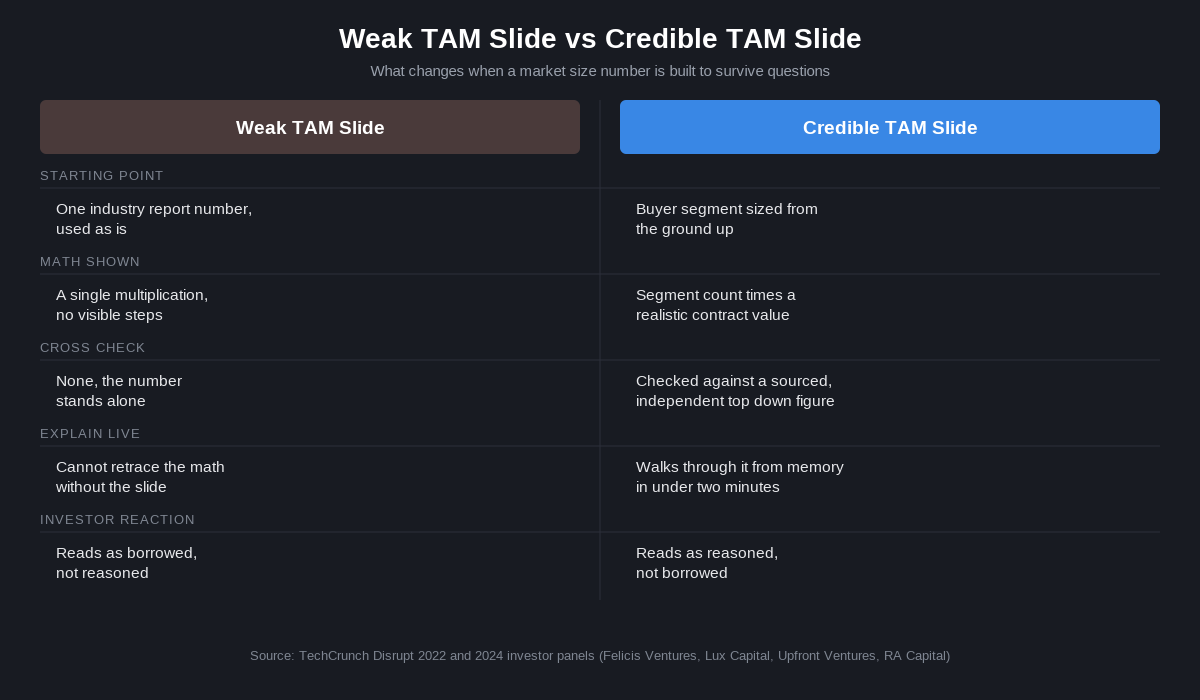
Top-down only, with no bottom-up cross check. Pulling one market size figure from an industry report and presenting it as your TAM is the fastest way to earn Senkut’s verdict. A number that is not tied to a real calculation, built from your own assumptions about buyers, price, and reach, reads as borrowed rather than reasoned.
Chasing the biggest defensible number instead of a believable first market. O’Brien’s trillion-dollar TAM slides are not rare because founders are dishonest. They are common because a bigger number feels safer to present. The founders who do better pick a specific, winnable first market, prove they can take it, and treat the larger category as a second act rather than the headline.
Letting the TAM slide stand in for the go-to-market plan. Nortman’s warning lands here directly: a TAM number is not a strategy. If the slide after your market size does not answer who you sell to first and how you reach them, the market size slide has done more harm than good, because it raised a question it did not answer.
Not being able to explain where the number comes from when asked. This is Shakir’s test, and it is the one most founders fail live in the room. If you cannot walk through your own math, segment by segment, in under two minutes, the number was never really yours.
What a credible TAM actually looks like
A TAM an investor can trust is triangulated, not borrowed. That means building it from the bottom-up first: define the specific buyer segment you can sell to today, count the real number of companies or users that fit that definition, and apply a realistic price or contract value based on what comparable companies actually charge. Then cross check that bottom-up figure against an independent top-down estimate from a credible public source. When the two numbers land in the same range, you have something you can defend. When they do not, that gap is itself useful, because it tells you which assumption is wrong before an investor finds it for you.
This is also why a TAM built by an independent research team tends to carry more weight in diligence than one a founder builds alone. It is not self-reported math from someone with an obvious incentive to make the number look good. It is a figure someone can trace back to a defined method, sources, and a named analyst who was not trying to raise money off the result, which is exactly the kind of scrutiny covered in what investors check once your TAM, SAM, and SOM are on the table.
A decision checklist before your next pitch
Before you present a TAM slide again, it is worth checking it against a short list. Can you name the exact buyer segment the bottom-up number is built from, not just an industry category. Can you cite the source and date behind the top-down number you are using as a cross check. Do the two numbers land within a reasonable range of each other, and if not, do you know why. Does the slide immediately after your TAM answer who you sell to first, not just how big the category is. And can you walk through the math out loud, from memory, in under two minutes, the way Shakir and Senkut both implied they will ask you to.
If more than one of those questions gives you pause, that is the gap a researched, third-party market sizing engagement is built to close, not by inventing a bigger number, but by giving you one you can actually defend. It belongs on the same pre-raise list as a proper market due diligence checklist for startups and investors.
Get a Defensible TAM for Your Startup
Frequently asked questions
Should an early-stage SaaS startup use a top-down or bottom-up TAM?
Both, triangulated against each other. A bottom-up estimate built from your actual buyer segment and pricing is what investors like Shakir and Senkut are listening for when they ask you to defend the number. A top-down figure from a credible industry source is useful as a sanity check, not as the number itself.
How big does a seed-stage SaaS TAM need to be to interest investors?
There is no fixed threshold that works across every category, and investors who focus only on the size of the number are not the ones most founders should be optimizing for. O’Brien and Nortman both point to the same underlying test: whether you have picked a specific, winnable first market and can show a real path to it, not whether your TAM slide clears a round number.
Can a founder build a credible TAM without hiring a research firm?
A first pass, yes, especially pre-seed. But once you are preparing for a priced round, an independently built and sourced TAM carries more weight in diligence than the same number presented as your own math, for the reason Shakir names directly: investors can tell the difference between a researched figure and one a founder got excited about.
Sources
Walter Thompson, “What investors really think about the TAM slide in your pitch deck,” TechCrunch, November 4, 2022 (TechCrunch Disrupt 2022 panel featuring Aydin Senkut of Felicis Ventures, Deena Shakir of Lux Capital, and Kara Nortman of Upfront Ventures). Tim De Chant, “Why founders shouldn’t chase massive TAMs,” TechCrunch, November 7, 2024 (TechCrunch Disrupt 2024, featuring Brigid O’Brien of RA Capital). CB Insights, startup failure reasons analysis of 431 VC-backed startups that shut down since 2023.