BI Blog
Market Due Diligence Checklist for Startups and Investors
Most due diligence checklists are financial and legal checklists wearing a market hat. A 2024 review of 65 broken lower-middle-market acquisitions found that deals failing over business underperformance rose from 4.3 percent to 12.3 percent of all broken deals in a single year, nearly three times over, while unresolved quality-of-earnings questions stayed the single biggest reason deals died, at 21.5 percent (Axial, Dead Deal Report, 2024 deal-year cohort). A separate breakdown of what actually kills deals in diligence names four standard categories: earnings quality, operational and legal risk, strategic fit, and valuation (KSM Insights, August 2026). Market evidence, whether the demand is real, how it was sized, and who else is already selling into it, is not one of the four. Most standard checklists were built for acquisitions, where a business already has revenue to audit. An early-stage raise is different: the market claim is the thing actually being bought, and that is exactly the category most startup checklists leave unchecked.
That gap is exactly where a startup’s own due diligence usually falls short, and exactly where an investor’s own analyst will start pulling threads. This checklist covers what the financial and legal side of diligence already does well, briefly, and then focuses on the market evidence category most founders underprepare: how to pressure-test a sizing method, where to find proof an investor cannot wave away, how to map a competitive set honestly, and how to package all of it into something a time-pressed analyst can actually review.
What a complete due diligence checklist covers
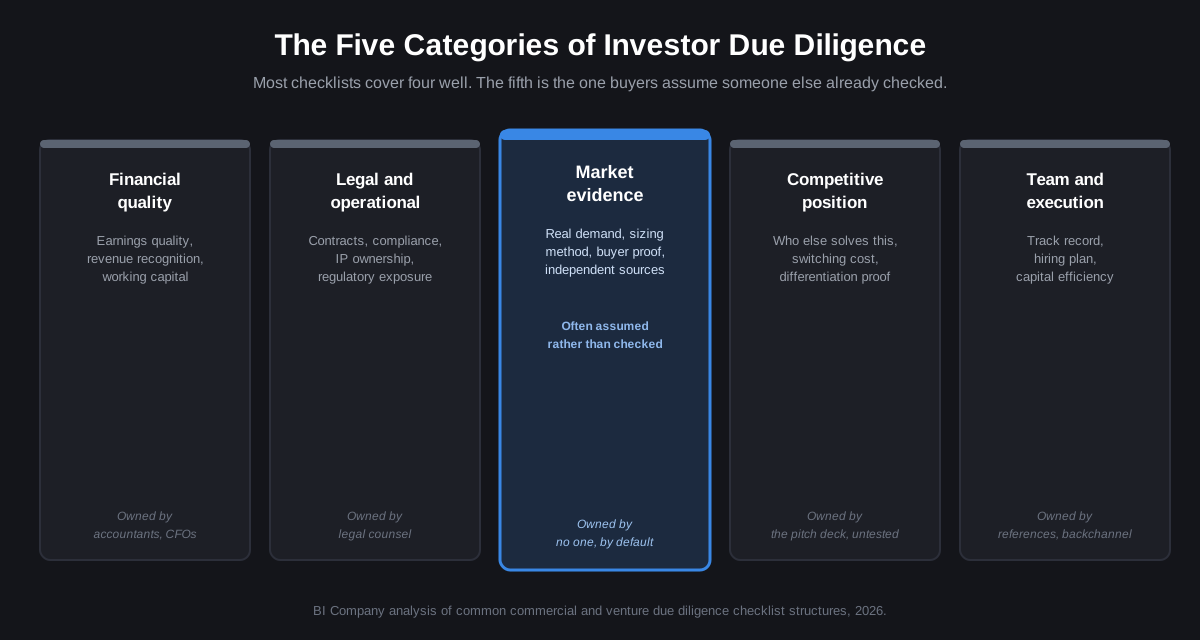
A due diligence checklist built for an early-stage raise has to cover five categories, not just the two that show up in a standard financial and legal review. Financial quality (earnings, revenue recognition, working capital) and legal and operational standing (contracts, compliance, IP ownership) are familiar territory, usually owned by an accountant or counsel the founder already has on retainer. Team and execution (track record, hiring plan, capital efficiency) gets tested informally, through references and investor backchannel conversations, whether or not it is written down anywhere. Competitive position (who else solves this problem, what it costs a customer to switch) usually lives only in the pitch deck, stated but not independently verified. Market evidence, real demand, a sizing method that survives scrutiny, and buyer proof from sources the company does not control, is the category most often assumed rather than checked, simply because no single person on a founding team is usually responsible for owning it the way a CFO owns the financial model.
Closing the market evidence gap, step by step
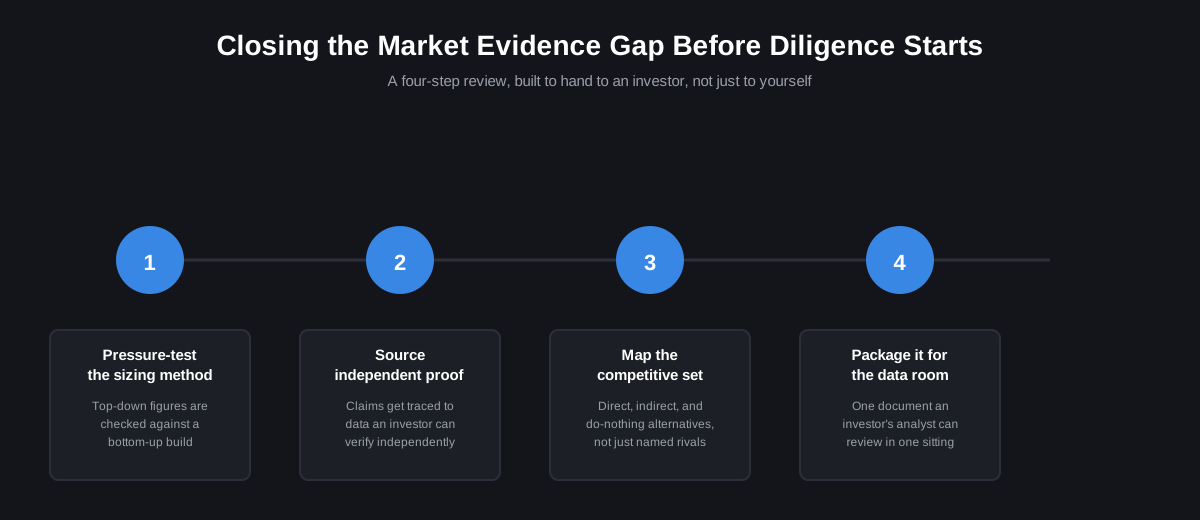
Once the gap is clear, closing it is a structured exercise, not a one-time slide update. The first step is pressure-testing the sizing method itself: a top-down market figure pulled from a single analyst report should be checked against an independent bottom-up build from the company’s own pricing, target account count, and realistic penetration rate, the same cross-check this site’s own TAM, SAM, and SOM guide walks through in more depth. The second step is sourcing proof an investor cannot dismiss as founder optimism: signed letters of intent, paid pilot data, or a structured survey of the actual buyer, not a handful of encouraging conversations at a conference. The third step is mapping the competitive set honestly, including the indirect alternatives and the option to do nothing, not just the two or three named rivals that make it into the deck. The fourth step is packaging all of it into one document an investor’s own analyst can review in a single sitting, with sources cited and methodology stated plainly, rather than leaving it scattered across a dozen slides and a founder’s memory.
The checklist
Before a raise, or before handing a data room to an investor, a founder should be able to answer all of the following without pulling a new number out of thin air.
Is the market size built bottom-up from pricing, target accounts, and a stated penetration assumption, not just lifted from a single market-research report. Is every demand claim traceable to a source outside the company, a pilot, a signed letter of intent, a structured survey, or a named customer. Does the competitive map include indirect alternatives and the realistic option of doing nothing, not only the two or three companies named in the deck. Is there a one-page summary of market evidence that a time-pressed analyst could review without asking the founder to explain it live. Has anyone outside the founding team, ideally someone without a stake in the answer, checked the sizing method and the sourcing before an investor does.
Frequently asked questions
Is a market due diligence checklist the same thing as a TAM, SAM, and SOM calculation?
No. TAM, SAM, and SOM is one input into market sizing, and this site’s own guide to what investors check in a TAM, SAM, and SOM figure covers that calculation in more depth. A market due diligence checklist is broader: it also covers how that figure was sourced, how the competitive set was mapped, and whether the evidence behind it would survive an outside analyst’s review, not just whether the math is internally consistent.
Why does market evidence get skipped more often than financial or legal diligence?
Mainly because financial and legal diligence usually has an owner by default, an accountant or a lawyer the company already works with, while market evidence often does not. SaaStr founder Jason Lemkin has made a related point about diligence generally: it is necessary, but it can become auto-confirming if nobody on the team is actively looking for the gaps rather than just defending the existing story.
Who should actually build this checklist, the founder or an outside analyst?
Either can start it, but an outside, independent review tends to catch what a founder close to the story cannot see in their own numbers, which is also the reason an investor’s own diligence process rarely accepts a founder’s self-assessment as the final word.
If the market evidence section of your own checklist is thinner than the rest, an independent market opportunity assessment is built to close exactly that gap before an investor finds it first.