BI Blog
Market Opportunity Assessment Services for Investors
Less than a fifth of the new businesses McKinsey tracked between 2011 and 2017 ever reached $50 million in annual revenue. More than half either shut down outright or never crossed $1 million. The companies that beat those odds were not the ones with the biggest budgets. McKinsey’s own research found that the businesses which outperformed were about 60 percent more likely to have sought deeper customer insight before they committed, through surveys and field research, not assumptions.
That is the gap a market opportunity assessment is built to close. Before an investor writes a check, before a corporate strategy team asks the board for budget, or before a company commits to a new product line or geography, someone needs a clear, evidenced answer to one question: is this opportunity real, and is now the time to act on it.
What a market opportunity assessment actually checks
A market opportunity assessment is a focused, evidence-based look at whether a specific opportunity, a new market, a new product line, a potential investment, or an acquisition target, is worth pursuing. It typically answers four things: how large and reachable the opportunity really is, who the buyer is and what they will actually pay for, how crowded or defensible the space is, and what would have to be true for the opportunity to pay off.
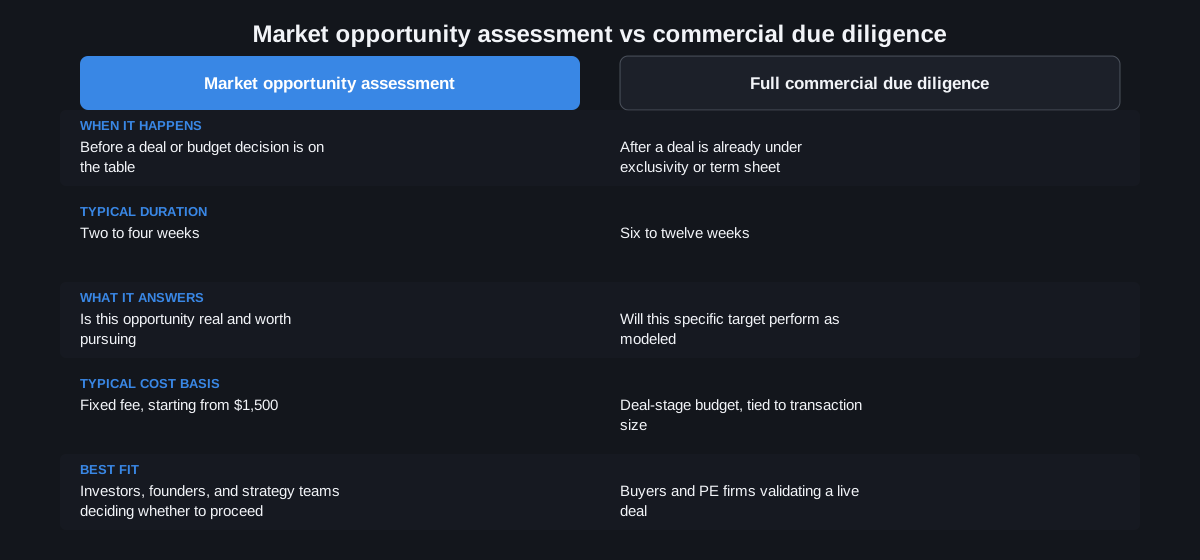
This is a different, lighter engagement than a full commercial due diligence process. Commercial due diligence is the deep, multi-week workstream that private equity and strategic buyers run once a deal is already on the table, usually alongside legal, financial, and operational diligence, to stress-test a specific target before signing. A market opportunity assessment is earlier and narrower: it is the evidence an investor, founder, or strategy team needs before they get to that stage at all, to decide whether an opportunity is worth the time, capital, or attention a full deal process would require.
Why this step gets skipped, and what it costs
Two pressures push this evidence step out of the process. The first is timeline. One widely cited study of roughly 700 venture capital firms, reported by Crunchbase News, found that a typical deal once took about 83 days to complete and that investors spent on the order of 118 hours on due diligence per deal. That window gets used up fast on financial, legal, and reference checks, and market evidence often ends up resting on a founder’s own slide deck rather than independent research, because there is no time left to commission it from scratch.
The second pressure is cost. A full commercial due diligence engagement from a strategy firm is built for a live deal with a defined budget behind it, not for the earlier question of whether an opportunity is worth that spend in the first place. The result, in both cases, is that a real investment or market-entry decision often gets made on secondhand numbers, a competitor’s public claim, or an internal projection nobody outside the deal team has tested.
McKinsey’s new-business research points at what that costs: the companies that built in deeper, independent customer and market evidence before committing were measurably more likely to be among the roughly one in five new businesses that actually scaled.
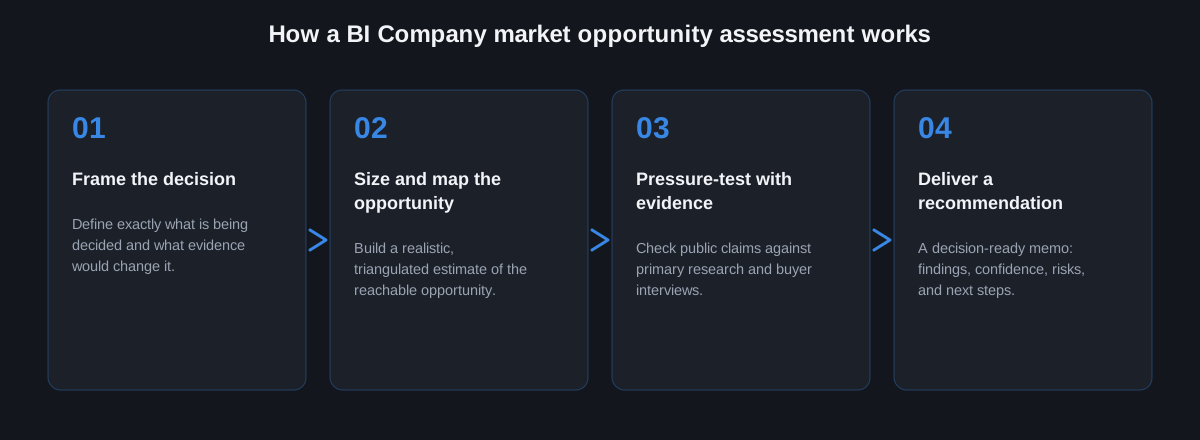
What is included in a BI Company market opportunity assessment
Every BI Company market opportunity assessment service is scoped to the specific decision in front of you, but most engagements include the same four moves.
Frame the decision. Before any research starts, we define exactly what is being decided, invest or pass, enter or wait, build or acquire, and what evidence would actually change that decision. This step alone catches a surprising number of opportunities that are being evaluated against the wrong question.
Size and map the opportunity. We build a realistic estimate of how large the addressable opportunity is and who within it is reachable with a credible go-to-market plan, using the same top-down and bottom-up triangulation described on our market sizing services page, scoped here to one specific opportunity rather than a full business plan.
Pressure-test with primary evidence. Public filings, industry reports, and competitor claims get checked against primary research, buyer interviews, targeted surveys, or direct product and pricing comparisons, so the final view is not just a repackaging of what is already public.
Deliver a clear recommendation. The output is a decision-ready memo, not a data dump: what we found, how confident we are in it, what would have to be true for the opportunity to work, and the specific risks worth watching before you commit further capital or time.
Who this is for
This service is built for three kinds of buyers. Investors, including venture capital, private equity, and corporate strategy teams, use it to get an independent read on a market before a deal moves further into a formal process. Companies evaluating a new product line, customer segment, or geography use it to test a growth decision before committing budget to it, the same evidence gap our market research for startups work addresses earlier in a company’s life. Consulting and advisory firms use it as outsourced capacity when a client engagement needs an independent market read faster than an internal team can staff it, consistent with how we support consulting firms more broadly.
It is not a fit for a live transaction that has already cleared legal and financial diligence and needs a full, deal-grade commercial due diligence report. For that stage, a strategy firm built for live deal timelines is the right call. A market opportunity assessment is the step before that, when the question is still whether the opportunity is worth pursuing at all.
Frequently asked questions
How is this different from your market sizing service?
Market sizing is one component of an opportunity assessment. A market opportunity assessment goes further, adding competitive positioning, buyer validation, and a clear recommendation on whether to proceed, not just a number.
How long does an assessment take?
Most engagements run two to four weeks depending on how much primary research, buyer interviews or a targeted survey, the question requires. We scope the exact timeline with you before starting.
Do you work alongside a strategy firm already running commercial due diligence on the same deal?
We have supported consulting and advisory teams as outsourced research capacity on exactly this kind of engagement. We are not a substitute for deal-stage commercial due diligence, we are typically earlier in the process or supporting the team running it.
What does this cost?
Engagements start from $1,500 and scale with scope, primary research intensity, and timeline. We provide a fixed quote before work begins.