BI Blog
AI in Market Research: What It Can and Cannot Do for You
By the middle of 2026, buyer side market researchers had increased how often they use AI for report writing ninefold year over year, according to the 2025 GRIT Insights Practice Report. A separate 2025 Qualtrics study, reported by Qualtrics’ own head of market research, found that 62 percent of researchers had already used synthetic data in the previous six months. Adoption is not really the open question anymore. The open question is which specific parts of a research project AI is genuinely good at today, and which parts still need a person who can be held responsible for the answer.
Search “AI in market research” right now and most of what ranks is written by AI tool vendors selling a platform, not by firms that actually run research for a living. That is a real gap for anyone trying to make a decision: a startup founder deciding whether a free AI summary is enough before a pitch, or a consulting firm wondering whether an outsourced research partner using AI tools is cutting corners. This is an honest answer from a firm that does both, grounded in what researchers themselves report, not in a product pitch.
Where AI genuinely helps
MIT Sloan associate professor John Horton, whose own research treats market research as fundamentally a prediction problem, describes generative AI’s best current use as a cheap dress rehearsal: a way to test three or four positioning, pricing, or messaging variants before committing budget to a full study. That framing matches what researchers report using it for day to day.
- Gathering and sorting raw data faster. Reviews, call transcripts, and open text survey answers can be processed at a scale no analyst could read line by line inside a billable budget.
- Drafting early versions of a persona or segment. A starting sketch to react to and correct, not a finished customer profile to act on.
- Running a cheap dress rehearsal before a bigger decision. Testing several positioning or pricing variants with simulated respondents to see which ones are worth researching properly.
- Surfacing a more candid first reaction. A simulated respondent can be blunter than someone talking to a live interviewer face to face, which is useful as a signal, not as a verdict.
Where you still need a human analyst
The 2026 GRIT Insights Practice Report found a cluster of “limiting beliefs” among the researchers who took part: AI is widely seen as replacing the human voice in a finding rather than amplifying it, most of the public conversation about AI centers on synthetic data and analysis of the past rather than new evidence, and a lot of what gets said about AI in research is, in the researchers’ own words, hype without a research method behind it. Horton’s own caution points at the same gap from the other direction: AI has what MIT Sloan’s reporting calls inherent flaws, and using it responsibly means having confidence that a given model’s output closely approximates real world behavior before it informs a decision, something a model cannot judge about itself.
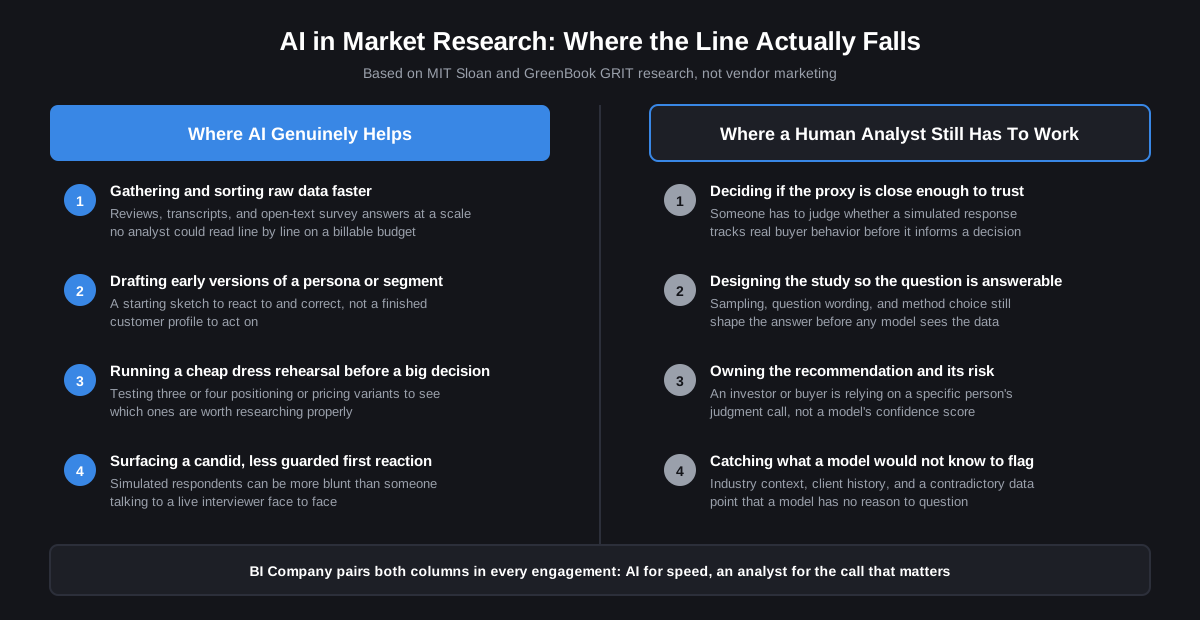
In practice, four jobs still sit squarely with a person, whatever tools are involved:
- Deciding if the proxy is close enough to trust. Someone has to judge whether a simulated response actually tracks real buyer behavior before it is allowed to inform a real decision.
- Designing the study so the question is answerable. Sampling, question wording, and method choice still shape the answer before any model ever sees the data.
- Owning the recommendation and its risk. An investor or buyer relying on a report is relying on a specific person’s judgment call, not a model’s confidence score.
- Catching what a model has no reason to flag. Industry context, a client’s own history, and a contradictory data point a model was never asked to question.
62% of researchers used synthetic data in the past six months. Almost none report trusting it unreviewed.
What this means if you are choosing between a DIY AI tool, a freelancer, and an outsourced research partner
A free AI summary is a reasonable first pass for a founder trying to sanity check an idea before spending real money. It is a weaker foundation for the number a pitch deck leans on or the figure a TAM, SAM, and SOM research engagement needs to survive investor diligence, because nobody has checked whether the model’s proxy for your buyer actually holds. The same logic applies to ongoing competitive intelligence: software can watch a competitor’s public signals continuously, but turning that feed into one specific recommendation still takes an analyst who knows what to ignore.
For a consulting firm weighing whether to outsource research capacity rather than hire, the same split applies at a larger scale: AI tools can shrink the time an analyst spends on data gathering, but the firm is still paying for the judgment that decides what the data means, and that judgment is exactly what does not scale with a subscription. A startup validating a new product idea faces the same choice earlier and with less room for a wrong call.
BI Company uses AI the way Horton describes it: as a dress rehearsal that narrows down what deserves a full, human led study, never as a substitute for the study itself. Every engagement is fixed price, starting from $1,500, and every deliverable has a named analyst who can defend the recommendation, not just the output of a model.
Frequently asked questions
Can AI replace market research?
Not yet, and not by itself. AI can speed up data gathering and give you a cheap first look at a question, but deciding whether that look is close enough to real buyer behavior to act on still requires a person who can be held responsible for the call, per MIT Sloan’s own reporting on the limits of AI based research simulation.
What AI tools does BI Company use in its research process?
AI is used for data processing, transcription, and early stage pattern spotting across unstructured sources like reviews and open text survey answers. Every finding that reaches a client report is reviewed, checked against independent sources, and signed off by a named human analyst before it goes out, consistent with BI Company’s standing evidence standards.