BI Blog
Competitive Intelligence Tools vs an Outsourced Analyst
A Forrester survey of 21 organizations that run a dedicated competitive intelligence function, published in January 2026, found that 13 of them operate with five people or fewer and eight have just one or two. Most of those same teams, 12 of the 21 surveyed, already use a dedicated competitive intelligence platform such as Klue, Crayon, or AlphaSense, and report being satisfied with it. The dashboards are live. The alerts fire the moment a competitor changes pricing or posts a new job listing. And according to the same survey, quantifying what any of that actually means for the business remains, in Forrester’s own words, one of the field’s biggest hurdles.
That gap is the real story. Search for competitive intelligence tools right now and almost everything that ranks is a vendor comparing feature lists, or a generic guide listing the same ten platforms. Almost none of it comes from a firm that has actually sat with a team trying to turn a monitoring feed into a decision a board will act on. This is that answer, grounded in what one of the industry’s own research houses just found, not a platform pitch.
What a competitive intelligence platform is genuinely good at
The Forrester survey is specific about where these tools earn their keep. Respondents point to three real benefits: sourcing broad, messy information from many places in near real time, fast search and summarization across that information, and automated distribution of the resulting briefs to the people who need them. For a five person team covering 500 to 5,000 internal users across sales, product, and marketing, that is not a small thing. It is the difference between a competitor’s pricing change reaching the right inbox in hours instead of being noticed weeks later in a sales call.
- Continuous monitoring. Pricing pages, job postings, product release notes, and review sites tracked automatically, without anyone checking manually.
- Fast summarization. Large volumes of scraped and submitted information condensed into a readable brief in minutes, not days.
- Built-in deliverable templates. The survey found the most common outputs teams already produce are competitive profiles and competitive landscapes, with about half of the surveyed organizations also producing sales battlecards.
- Distribution at scale. One alert or brief reaching hundreds of stakeholders without a human manually forwarding it.
None of that is a small efficiency gain. It is also, per the same survey, not the part of the job that is actually hard.
What the platform does not fix
Forrester’s own guidance to these teams is blunt: invest in process before tools, because a platform can only streamline work that already rests on a sound research method and clear standards, not replace the absence of one. The survey’s own measurement findings back that up. Teams most often track volume, how many briefs were produced, how many processes were supported, how many people opened the alert, rather than outcomes. Just over one third of the surveyed organizations can report their own win rate. Harder outcomes still, revenue influenced, a campaign’s actual performance, time genuinely saved, are described in the survey as harder to capture than any of the activity metrics a platform reports by default.
That is not a knock on the software. A platform was never built to tell you whether entering a specific market this quarter is the right call, or what to actually say when a competitor cuts price 15 percent two weeks before your renewal. It tells you that the price changed. Someone still has to decide what that means and be willing to put their name on the recommendation.
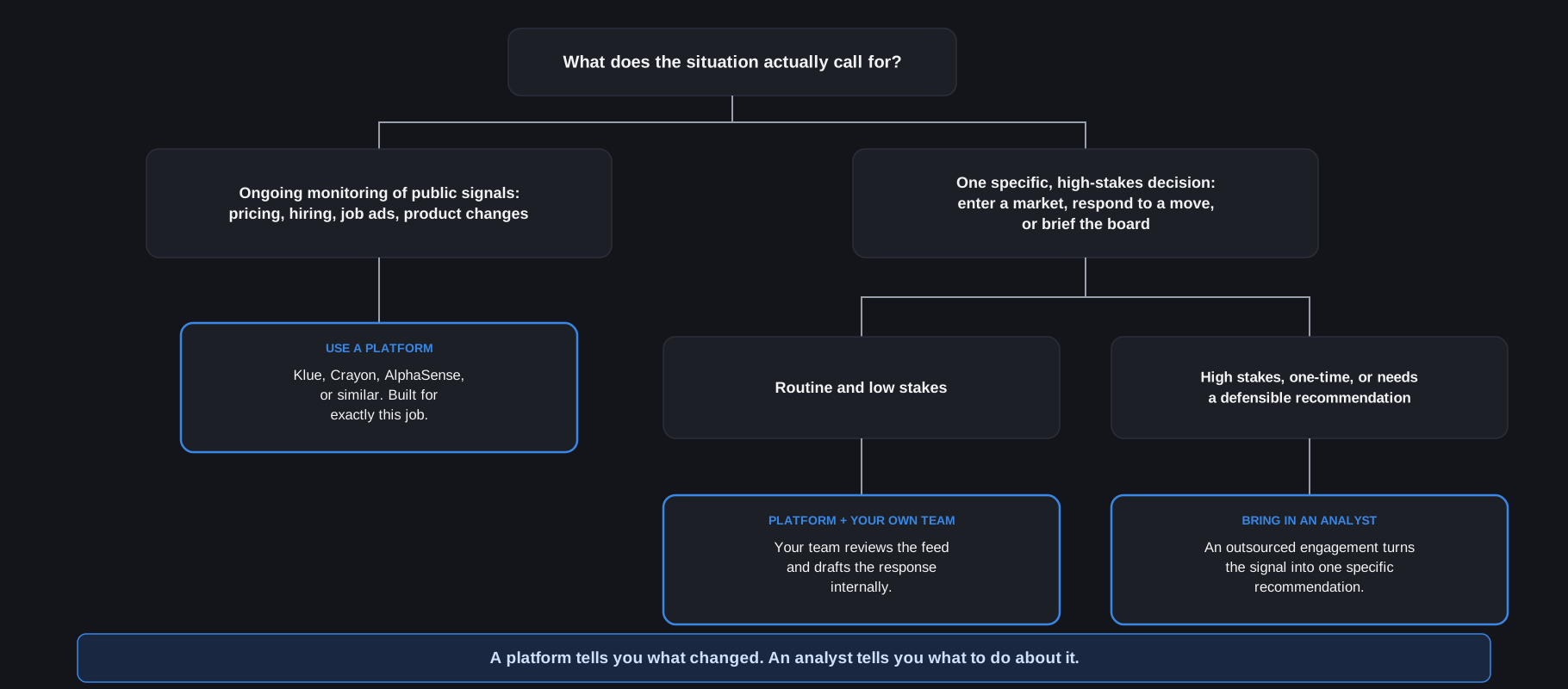
Platform, Team, or Analyst: Which One Do You Need?
The decision is not really tool versus no tool. In Forrester’s small but telling survey, most teams already have one. The actual fork in the road is what the situation in front of you calls for.
- Ongoing monitoring of public signals (pricing, hiring, product changes) is exactly what a platform like Klue, Crayon, or AlphaSense is built for. Buying an analyst’s time to watch a dashboard is a waste of both.
- A routine, low stakes read on what the feed is showing is usually well within a small internal team’s own judgment, especially once the platform has done the sourcing and summarizing for them.
- A specific, high stakes decision, entering a new market, responding to a competitor’s move, briefing the board before a raise, needs a defensible, specific recommendation, not another dashboard. That is where bringing in an outsourced research team earns its cost: a named analyst who synthesizes the signal into one answer and can defend it under questioning, the same way AI tools speed up data gathering but still leave the judgment call to a person.
A platform reports change. An analyst makes the call.
BI Company’s own competitive intelligence engagements are built on exactly this division of labor. We do not sell a monitoring tool, and we do not ask a client to cancel the one they already have. A fixed price engagement, starting from $1,500, takes whatever a platform’s feed is already showing and turns it into the one specific recommendation a board, an investor, or a leadership team can actually act on, with a named analyst who stands behind the answer.
Frequently asked questions
Will software eventually replace a competitive intelligence analyst?
Not based on what the organizations actually using these platforms report. Forrester’s survey found the deliverables these teams value most, competitive profiles, market sizing and trend analysis, landscape maps, all require judgment about what a set of signals means, not just faster access to the signals themselves. The platforms in use today are described as speeding up sourcing and distribution, not as replacing that judgment.
If I already pay for a competitive intelligence platform, do I still need an outsourced analyst too?
Only when the situation calls for it. A platform is built for ongoing monitoring, and a small internal team can usually read its output for routine, lower stakes questions. An outsourced engagement earns its cost specifically for the high stakes, one time decisions, a market entry, a competitive response, a board briefing, where the cost of a wrong or indefensible call is far higher than the price of getting an outside analyst’s name on the answer.