Make an order Mobile button

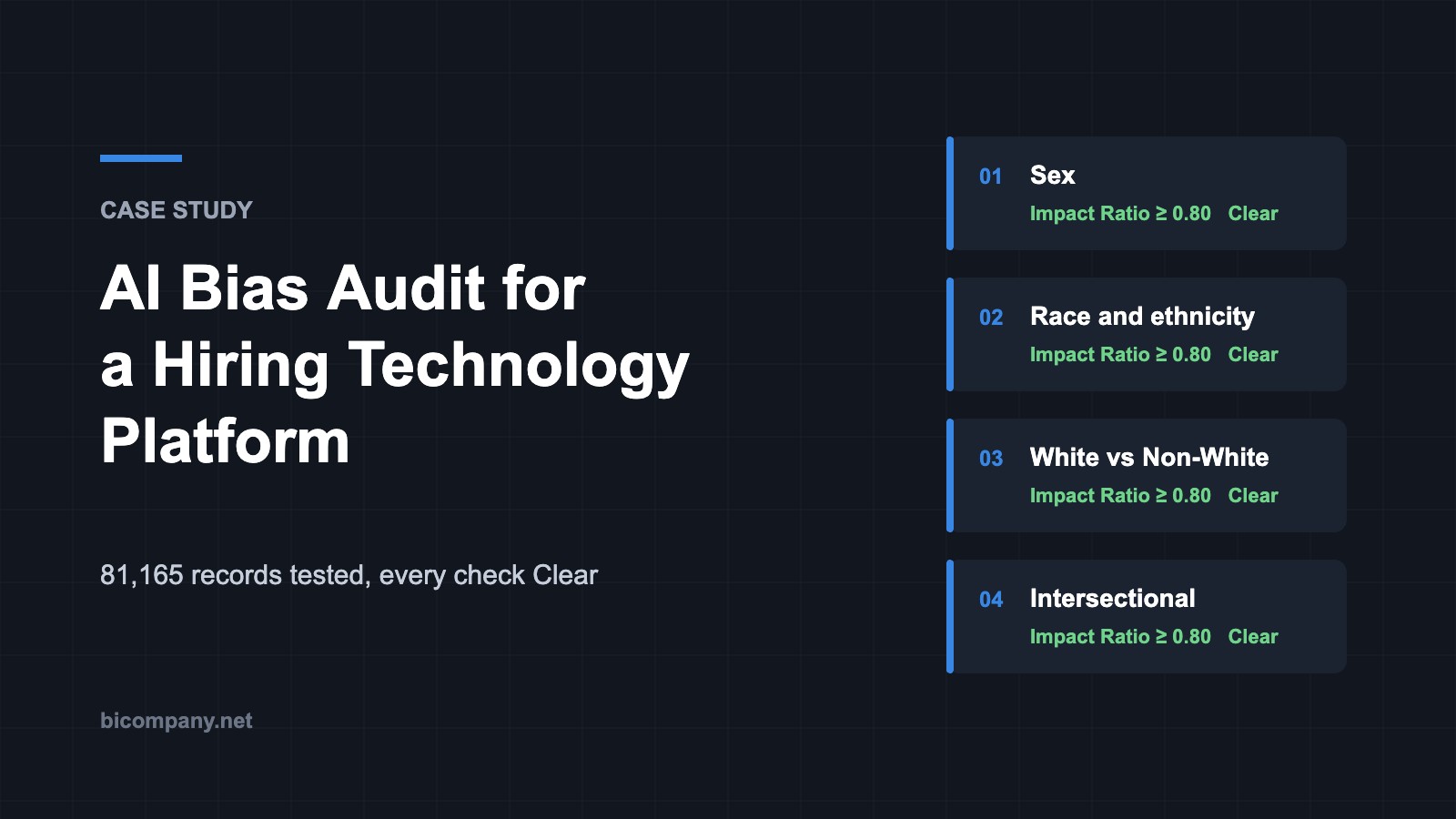
AI Bias Audit for a Hiring Technology Platform

Problem and
goals

01

Problem: An AI-powered hiring and candidate-scoring platform needed an independent, annual bias audit to comply with NYC Local Law 144, which requires employers and employment agencies using Automated Employment Decision Tools to undergo an independent bias audit and publicly summarize the results.

Goal: Determine, with statistical rigor and no intervention in the live system, whether the platform’s scoring outputs showed adverse impact across sex, race and ethnicity, the White versus Non-White binary, and every relevant intersectional subgroup, and deliver a report the client could publish to meet its legal obligation.

Geography: United States, New York City jurisdiction.

What was done to solve the problem
and reach the goals

02

Stage 1: Data intake and preparation

The client provided anonymized historical candidate-scoring records as CSV data, alongside system configuration and output data as JSON. No synthetic or simulated data was used, every record reflected a real, historical scoring decision the system had already made. BI Company did not access or modify the live system at any point.

Stage 2: Demographic classification

Because the platform does not directly collect race, ethnicity, or gender, BI Company inferred these attributes using established, disclosed methods: a name-to-gender inference approach for sex, and Bayesian Improved Surname Geocoding, which combines surname and geography, for race and ethnicity.

Stage 3: Statistical testing

BI Company ran four separate analyses in SPSS against the full dataset of 81,165 historical candidate-scoring records, covering a one-week audit window in the summer of 2025:

  • Sex bias: a Chi-square test and Adverse Impact Ratio comparing male and female selection rates
  • Race and ethnicity bias: selection rate and Impact Ratio across five groups, Arabic, Asian, Black, Hispanic or Latino, and White
  • White versus Non-White bias: a Chi-square test and Adverse Impact Ratio on the binary grouping
  • Intersectional bias: selection rate and Impact Ratio for every combination of sex and race or ethnicity

Stage 4: Grading against a fixed standard

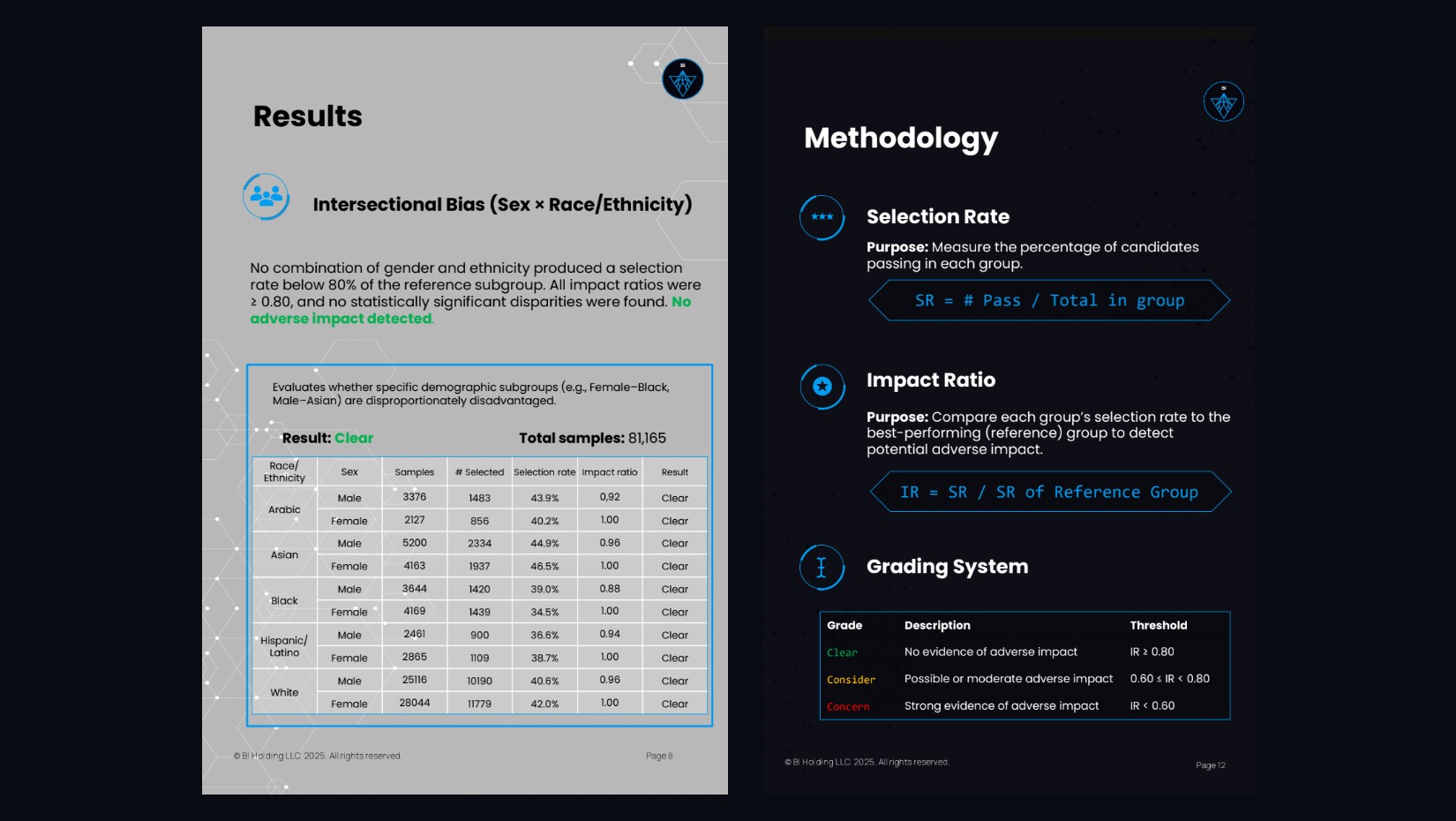
Every result was measured against the EEOC’s four-fifths rule (an Impact Ratio below 0.80 signals potential adverse impact) and graded on a three-tier scale: Clear (0.80 or above), Consider (0.60 to 0.79), or Concern (below 0.60). The platform’s own pass threshold for an individual candidate score was a composite score of 60 points or higher, a separate, product-level threshold from the audit’s own statistical grading scale.

Talk
to us

03

If your organization needs an independent AI bias audit for NYC Local Law 144, or wants an audited trust signal for an AEDT you sell to enterprise customers, talk to our research team. See our AI bias audit services page for the full methodology.
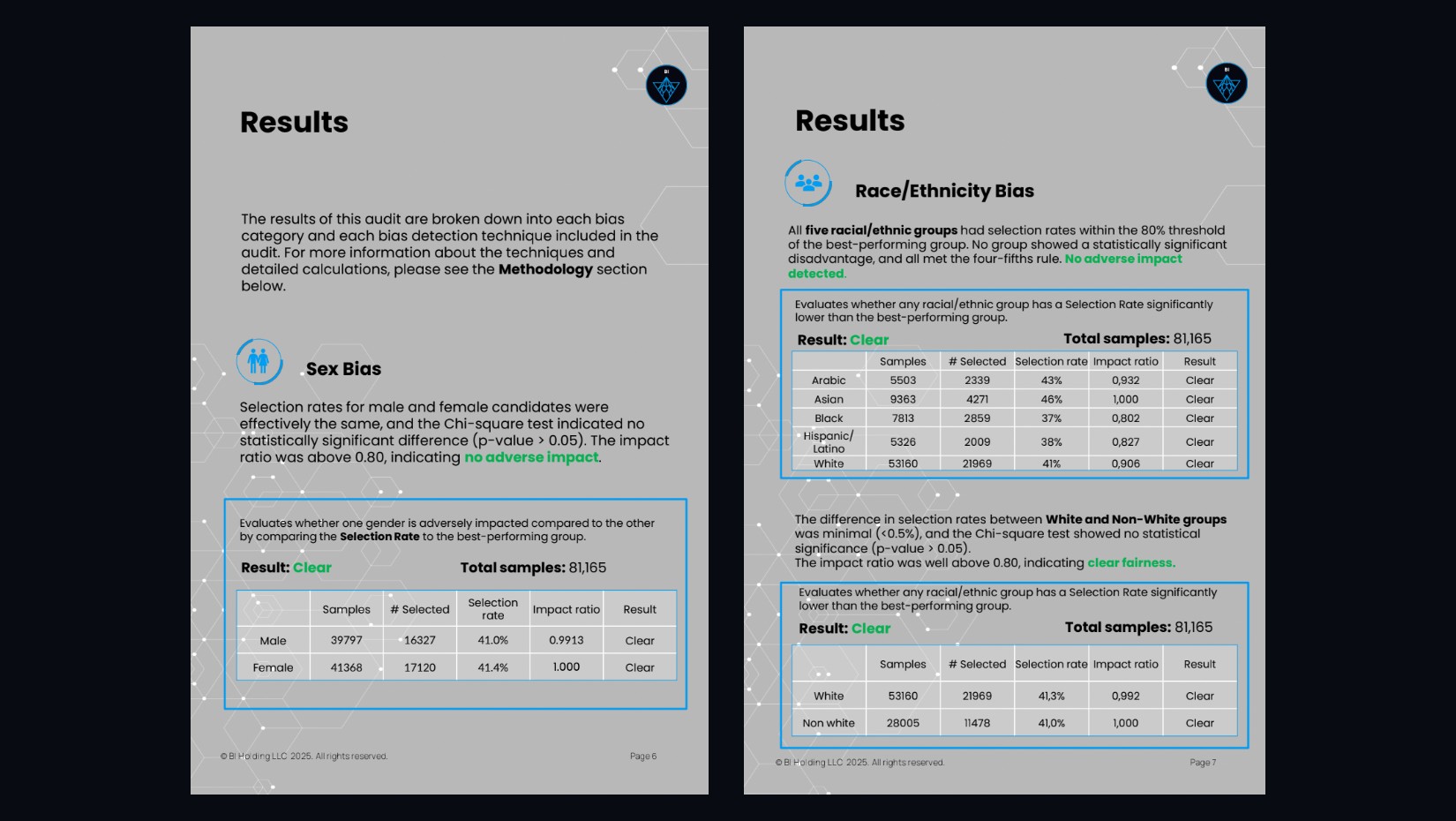
AI bias audit report pages: sex bias and race and ethnicity bias results tables, all graded Clear
AI bias audit report pages: intersectional bias results table and the selection rate, impact ratio and grading system

Project
results

04
  • 81,165 historical candidate-scoring records analyzed, the full population provided for the audit window, not a sample
  • Sex bias: Clear. Male applicants, 39,797 records, 41.0 percent selection rate. Female applicants, 41,368 records, 41.4 percent selection rate, used as the reference group. Impact Ratio 0.9913
  • Race and ethnicity bias: Clear across all five groups tested. Selection rates ranged from 37 percent (Black, 7,813 records) to 46 percent (Asian, 9,363 records), with Impact Ratios from 0.802 to 1.000. White applicants (53,160 records) scored a 41 percent selection rate and a 0.906 Impact Ratio
  • White versus Non-White bias: Clear. White applicants, 53,160 records, 41.3 percent selection rate. Non-White applicants, 28,005 records, 41.0 percent selection rate, used as the reference group. Impact Ratio 0.992
  • Intersectional bias (sex by race or ethnicity): Clear across every subgroup combination tested, with Impact Ratios in the roughly 0.88 to 1.00 range
  • Overall finding: no statistically significant adverse impact was found across sex, race and ethnicity, the White and Non-White binary, or their intersections, within the scope of this audit. As with any bias audit, this is evidence the system performed equitably on the data and dimensions tested during this specific window, not an absolute guarantee that bias is impossible under every future condition
  • The client received a decision-ready audit report formatted for public posting under NYC Local Law 144’s disclosure requirement

Contact us to get a precise estimation for your project

Start making your strategic decisions fast, easy, and massively successful by contacting BI market intelligence today.

Contact image